Viking Legends: The Greatest Norse Stories Ever Told
Long before books, long before cinema, long before any screen glowed in a darkened room, there were the Norse sagas. On winter nights in longhouses lit by firelight and thick with woodsmoke, skalds — the poets and storytellers of the Viking world — would unspool tales so vivid, so terrifying, and so magnificently strange that they have never entirely left us. These aren’t just old stories. They are the product of a culture that looked at the cosmos, at death and time and chaos, and decided the only honest response was to fight bravely and die well. The Viking legends are, at their core, about how to be human in a world that doesn’t owe you anything.
The Creation of the World: From Chaos and Ice
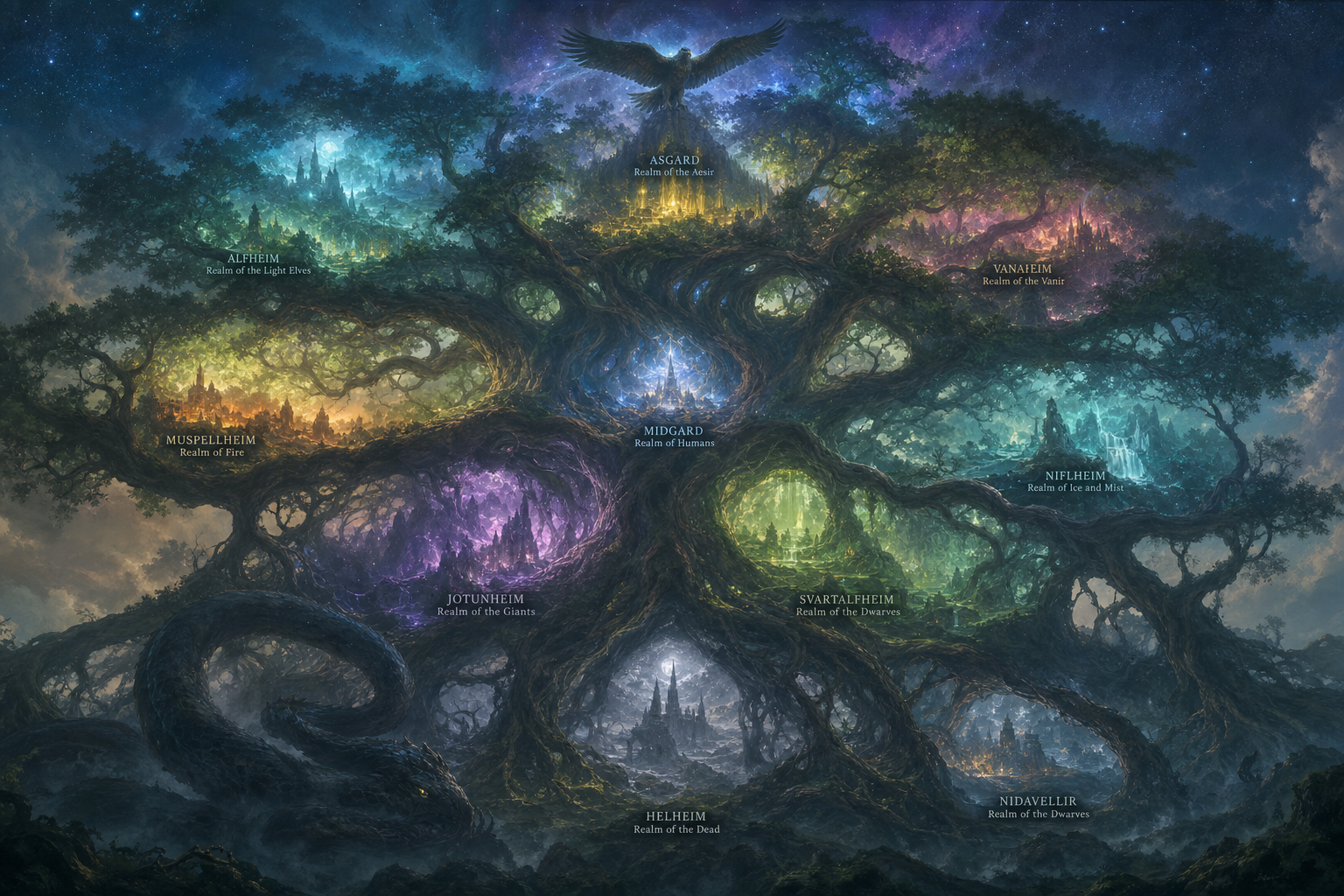
In the beginning, there was nothing but Ginnungagap — a vast, yawning void, empty and silent. To the north was Niflheim, the realm of ice and mist. To the south was Muspelheim, the realm of fire. When the cold rivers of Niflheim met the heat of Muspelheim at the void’s heart, ice melted, and from the dripping rime a being took shape: Ymir, the first frost giant.
Ymir was nourished by Audhumla, a great cow who licked salt from the ice and gradually uncovered Buri, the first of the Aesir gods. Buri’s grandson was Odin, and it was Odin who, with his brothers Vili and Ve, slew Ymir. The gods shaped the world from Ymir’s corpse — his flesh became the earth, his blood the seas, his bones the mountains, his skull the sky, his brains the clouds. The maggots in his flesh became the dwarves. Then Odin and his brothers fashioned the first humans — Ask and Embla — from two trees, breathing into them life, sense, warmth, and speech.
The Norse cosmos was built from blood and bone and ice. There is no pristine divine genesis here — and perhaps that’s why it feels so real.
Odin and the Runes: The Price of Wisdom
If you want to understand Odin, you have to understand what he was willing to pay for knowledge. Because Odin did not receive his power as a gift. He bought every scrap of it, and the price was always steep.
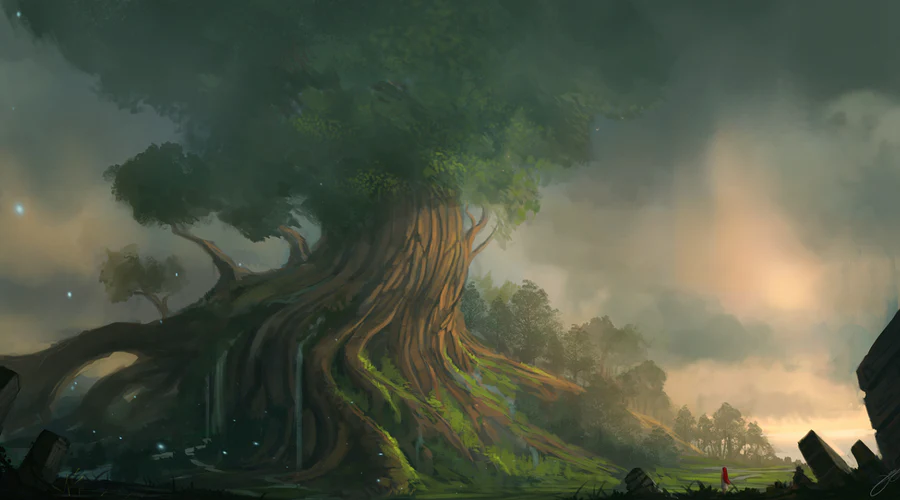
To gain knowledge of the runes — the sacred symbols that contain the secrets of existence — Odin hung himself on Yggdrasil, the World Tree. He hung for nine days and nine nights, wounded by his own spear, with no food and no water, offered to himself by himself. On the ninth day, he looked down into the depths beneath the tree and the runes revealed themselves to him. He seized them, screaming, and fell.
The runes were not merely an alphabet. They were forces — each one a concept, a power, a key. To know the runes was to have access to the underlying grammar of reality. This is the spirit that has drawn so many to Norse symbolism. Runic Viking pendants aren’t merely decorative — they carry the weight of this tradition, the idea that symbols are real, that letters can be keys, that meaning is inscribed in the world for those with eyes to read it.
Sigurd and Fafnir: The Dragon Slayer
The Volsung Saga is the Norse equivalent of the Iliad: a vast, sweeping tragedy of heroism, betrayal, cursed gold, and doom. At its centre is Sigurd, the greatest warrior of the Norse world, and his encounter with Fafnir — a dwarf who transformed into a dragon to guard a hoard of gold cursed by the gods themselves.
Fafnir had driven his brother Regin away, taken the cursed gold to a heath, and lay on it — consumed by greed and paranoia, he slowly transformed into a dragon. Regin, now a master smith and foster-father to the young Sigurd, forged the sword Gram and sent Sigurd to kill Fafnir. Sigurd dug a trench in the path Fafnir took to water, lay in it, and drove Gram up through the dragon’s soft belly as the great worm passed over him.
Fafnir died slowly, and as he died he warned Sigurd that the gold was cursed, that it would destroy him too. “All men must die,” Sigurd replied, in essence. “Better to die with gold than without it.” He took the hoard, knowing exactly what he was doing. The legend doesn’t end there — it spirals into betrayal, love potions, murder, and the deaths of virtually everyone involved. But Sigurd’s confrontation with Fafnir is the heart of it: a man who walks knowingly into his fate with his eyes open.
The Binding of Fenrir: When the Gods Were Afraid
Among all the monsters in Norse mythology, Fenrir, the great wolf, is the one who made the gods genuinely afraid. Fenrir was the son of Loki — a wolf who grew so large and so fast that the gods became convinced he would eventually devour them all. The prophecies agreed.
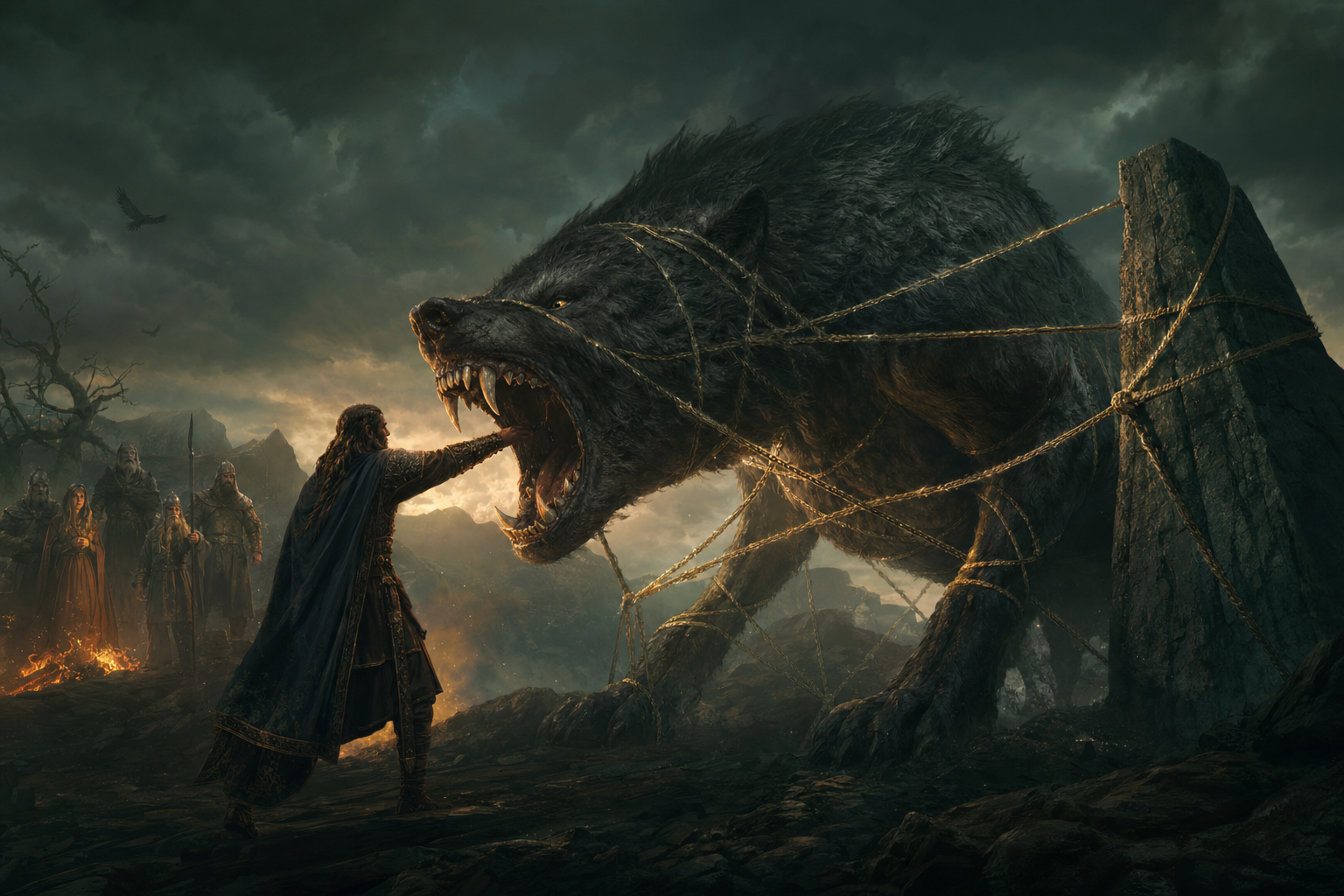
Every chain they brought to Fenrir, he snapped. Leyding broke. Dromi, twice as strong, broke. So the gods commissioned the dwarves to make something unbreakable. The dwarves created Gleipnir: a ribbon made from the sound of a cat’s footstep, the beard of a woman, the roots of a mountain, the sinews of a bear, the breath of a fish, and the spittle of a bird — six things that do not exist, and therefore cannot be broken.
Fenrir agreed to the test only if one of the gods placed their hand in his mouth as a pledge of good faith. Every god refused — except Tyr, the god of justice. Tyr put his hand in Fenrir’s mouth. Fenrir strained against Gleipnir and could not break it. He was bound. And Tyr lost his hand to the wolf’s closing jaws — willingly, because someone had to pay the price for the world’s safety.
The story raises an uncomfortable question: was this just? The gods lied to Fenrir. They used his good faith against him. Tyr’s sacrifice was real, but so was the deception. Norse mythology doesn’t try to resolve this. The gods do what they must, and they pay for it, and the universe ticks on.
Thor’s Fishing Trip with Jormungandr
Not every Norse legend is cosmically tragic. Some are gloriously, deliberately absurd — and none more so than the story of Thor’s fishing trip with the giant Hymir, in which the thunder god uses an ox head as bait to fish for the Midgard Serpent.
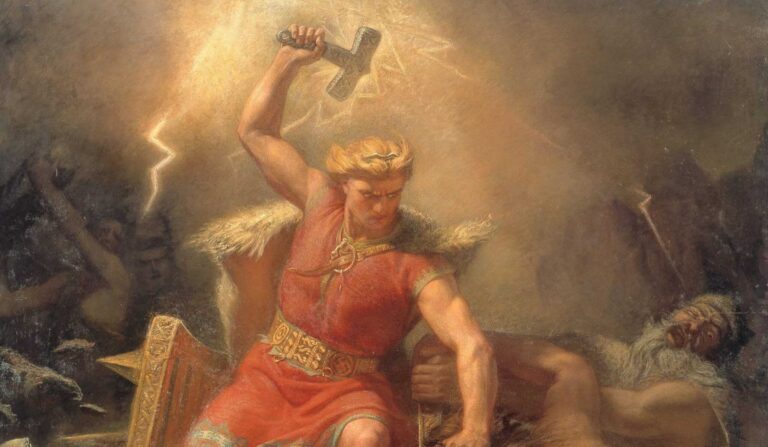
Thor rows out past safe waters, far out to where the sea goes dark and deep. He attaches the head of Hymir’s largest ox to a hook. He drops the line. And from the deepest darkness, Jormungandr — the World Serpent so vast it encircles all of Midgard — takes the bait. Thor hauls on the line so hard his feet go through the bottom of the boat. Jormungandr pulls back with the force of a world. Both surface, facing each other across the gunwale — the god of thunder and the serpent that will kill him at the end of the world, eyeball to eyeball over a fishing rod. Hymir, understandably, is having a terrible time.
Thor raises Mjolnir to deliver the killing blow — and at this moment, Hymir, terrified, cuts the fishing line. Jormungandr sinks back into the deep. Thor wades back to shore, soaking wet, furious. It’s funny. It’s genuinely funny. But it’s also poignant, because both Thor and Jormungandr know this was a preview. The real confrontation comes at Ragnarok, and there will be no cut fishing line to save either of them.
Mjolnir — Thor’s hammer — became the most widely worn symbol in the Norse world. Modern Viking bracelets and pendants bearing the Mjolnir symbol continue that tradition, connecting the wearer to the most beloved of the Norse gods.
Ragnarok: The Twilight of the Gods
Everything in Norse mythology leads here. The signs will be unmistakable. First, the Fimbulwinter: three years of winter without summer. The bonds of family will break. Brother will kill brother. Then the wolves Skoll and Hati will swallow the sun and moon. Stars will fall from the sky.
Loki will break free. Fenrir will shatter Gleipnir. Jormungandr will rise from the ocean. Naglfar, the ship of the dead built from human fingernails, will sail. Surtr will lead the fire giants from Muspelheim.
The gods will meet them on the field of Vigrid. Odin will face Fenrir — and the great wolf will swallow him whole. Thor will kill Jormungandr and then take nine steps and die of its venom. Freyr will fall to Surtr. Tyr and the hound Garm will kill each other. Loki and Heimdall will kill each other. Surtr will fling fire across all the nine worlds. The earth will sink into the sea.
And then — and this is the part that often gets overlooked — the earth will rise again. Green, renewed. The surviving gods will meet on the plain of Idavoll. Two humans will emerge from the World Tree. The sun’s daughter will take her mother’s place. Baldr will return from Hel. The cycle begins anew.
Ragnarok is not a story about despair. It is a story about a culture that looked at the inevitability of endings and chose to meet it with defiance and honour. That’s why these legends endure. That’s why people still wear the Valknut, the Vegvisir, the Mjolnir. Those symbols carry the weight of a worldview that took the worst the universe could offer and turned it into something worth living by. Carry these stories with you — and explore our full range of Viking bracelets and Viking pendants bearing the symbols of the Norse world.
Frequently Asked Questions About Viking Legends
Are Viking legends and Norse mythology the same thing?
They overlap considerably but aren’t identical. Norse mythology refers to the religious and cosmological beliefs found primarily in the Eddas — the Prose Edda by Snorri Sturluson and the Poetic Edda. Viking legends can also include historical and semi-historical sagas like the Volsung Saga, which blend history with mythology. The Eddas are the main primary sources for the mythological tradition.
Did Vikings actually believe in Ragnarok?
Norse religion was a living tradition that varied by region and changed over time. The Ragnarok myth as we have it was written down in Christian-era Iceland, and scholars debate how much represents genuine pre-Christian belief versus literary elaboration. What seems clear is that the Norse had a cyclical view of time and a genuine belief in a prophesied end-time that was taken seriously rather than treated as allegory.
Who was the most important god in Viking mythology?
Odin was nominally the chief of the gods, but Thor was arguably more widely worshipped by ordinary people. Odin was the patron of kings, poets, and glory-seeking warriors; Thor was the protector of farmers, sailors, and the common man. Thor amulets (Mjolnir pendants) are by far the most commonly found religious artefact in Viking-era archaeological sites.
What is the best way to learn more about Viking legends?
Start with the Prose Edda by Snorri Sturluson, which gives a systematic overview of Norse mythology. The Poetic Edda is older and stranger — harder to read but closer to the original tradition. Kevin Crossley-Holland’s retelling of the Norse myths is a beautiful modern introduction, and Neil Gaiman’s Norse Mythology is an accessible popular version. For historical sagas, Njals Saga and the Vinland Sagas are excellent entry points.