Viking Boat Facts: Everything You Need to Know About the Legendary Longship
Few vessels in human history have captured the imagination quite like the Viking longship. Lean, fast, and terrifyingly efficient, these ships didn’t just carry Norse warriors across the sea — they were the Viking Age. They opened up trade routes from the icy fjords of Norway to the sun-baked harbours of Constantinople, allowed raiders to appear from nowhere and vanish before a defence could be mounted, and carried entire communities to new lives in Iceland, Greenland, and even North America. Understanding Viking boats means understanding the Vikings themselves — a people defined by their mastery of the water.
Types of Viking Ships: Not Just Longships
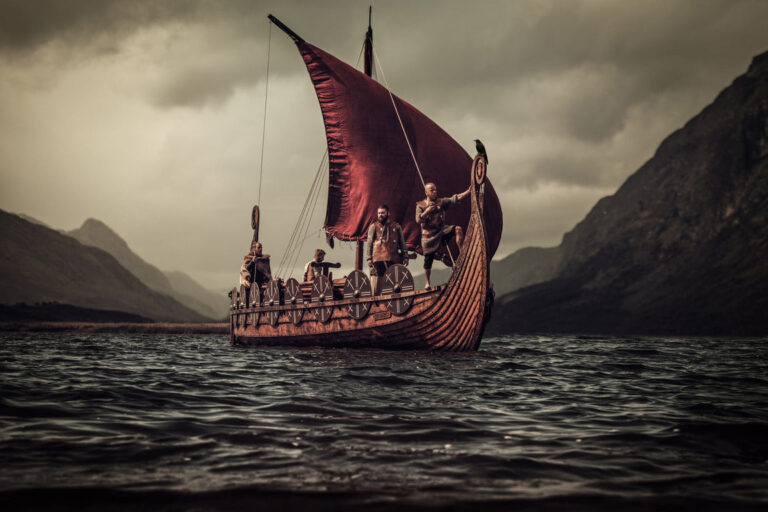
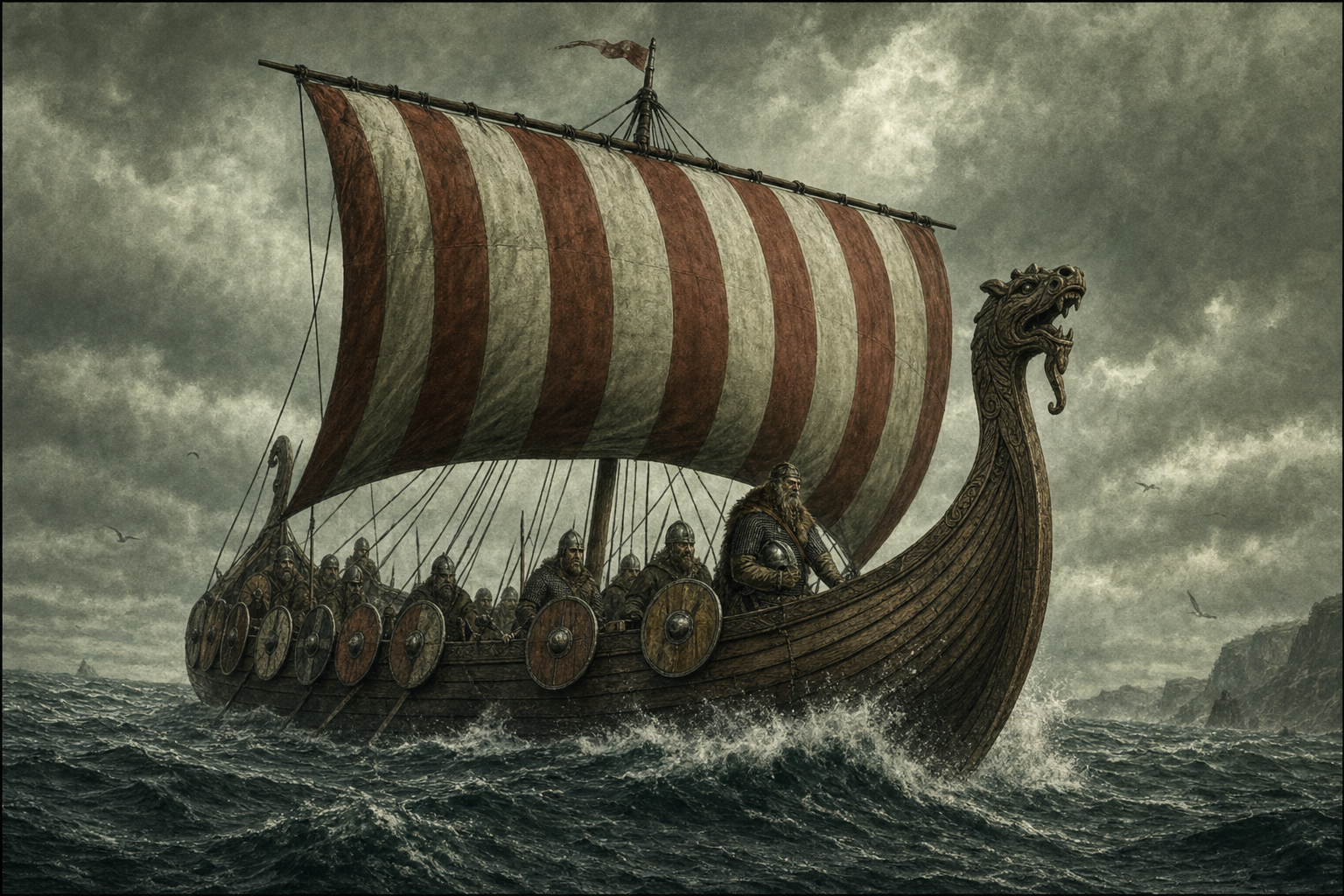
When most people picture a Viking ship, they see the same image: a long, narrow war galley bristling with round shields along the gunwales, a striped sail catching the wind, and a carved dragon’s head rearing at the prow. That image — the longship — is real and iconic. But it’s only part of the story. The Norse were sophisticated shipbuilders who designed different vessels for different purposes.
The longship (langskip) was the weapon of war and the vessel of prestige. Built for speed and shallow draught, it could beach directly on a coastline — no harbour required. The largest, known as drekkar or dragon ships, could carry 60 to 80 warriors and were the flagships of powerful jarls and kings.
The snekkja was a lighter, faster variant — typically crewed by around 40 men. Their shallow draught let them dart up rivers that heavier ships couldn’t navigate, which is precisely why monasteries built inland felt no safer than coastal settlements.
The knarr was a merchant vessel — broader and deeper than the longship, designed to carry cargo across open ocean. Knarrs are the ships that crossed the North Atlantic. Leif Eriksson didn’t conquer North America in a war galley; he sailed there in a sturdy trading vessel.
Clinker Construction: The Secret to Their Success
What made Viking ships so extraordinary wasn’t just their design — it was how they were built. Norse shipwrights developed clinker construction (also called lapstrake), in which the hull planks overlap one another like the scales of a fish. Each plank was riveted to the one below with iron rivets, creating a hull that was simultaneously rigid and flexible.
That flexibility is the key insight. A clinker-built hull could twist and flex in heavy seas without cracking. Rather than fighting the ocean, it moved with it. Modern testing has confirmed that this flexibility actually reduces structural stress rather than increasing it.
The wood of choice was oak, split radially from the log. The hull was sealed with tarred animal hair or wool packed into the overlapping seams. The construction required no formal blueprints — master shipwrights carried the design in their heads and their hands, passing knowledge from generation to generation through apprenticeship. The result was a hull so thin — sometimes less than 2.5 cm thick — that the finished ship weighed remarkably little, allowing it to be carried overland between river systems when necessary.
The Most Famous Viking Ships Ever Found
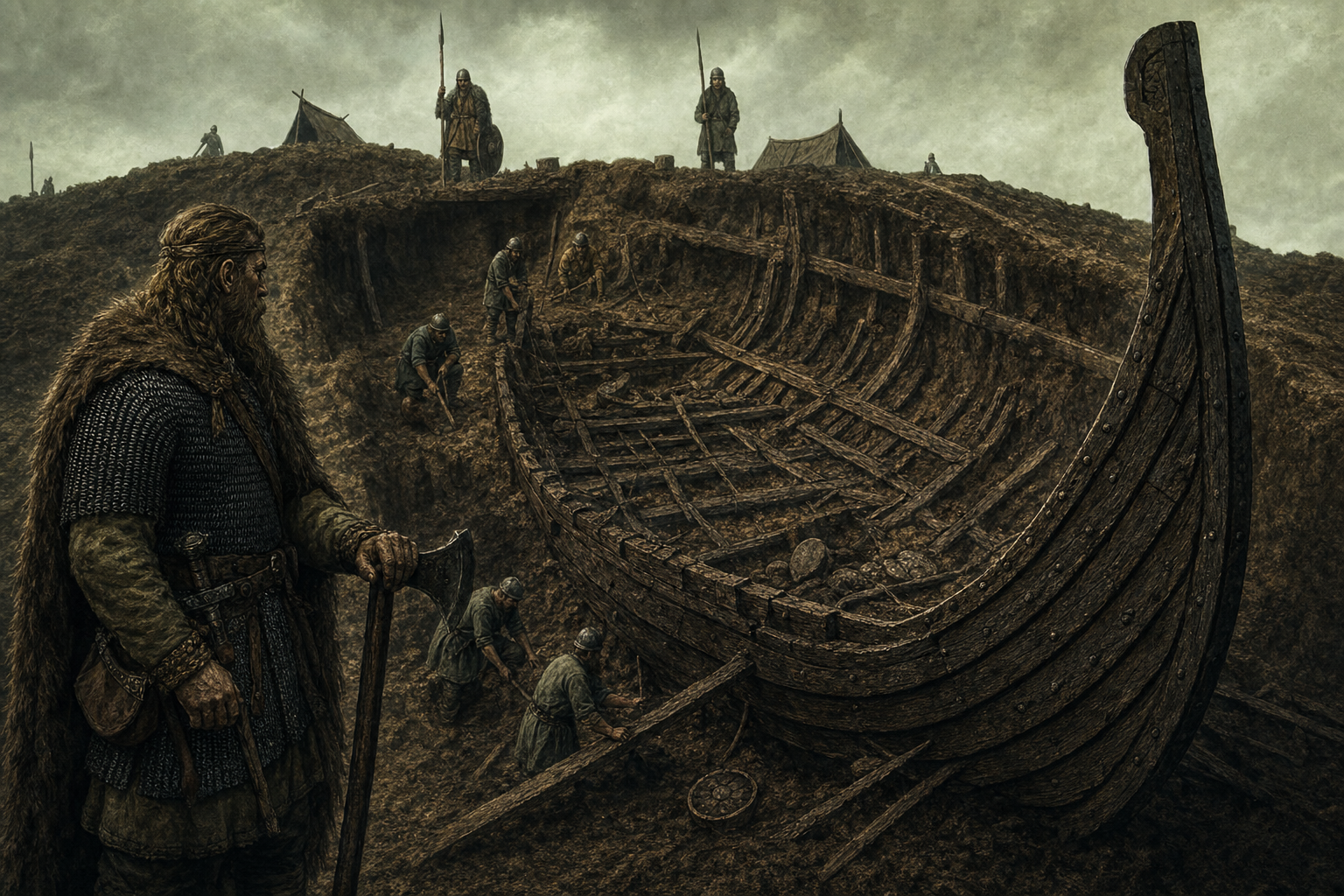
The Gokstad Ship, excavated in Norway in 1880, is perhaps the finest surviving Viking longship. Built around 890 AD, it measures 23.3 metres long. When a full-scale replica crossed the Atlantic in 1893 to reach the World’s Columbian Exposition in Chicago, it completed the journey in 28 days — reaching speeds of 11 knots in favourable conditions.
The Oseberg Ship, discovered in 1904, is even older — built around 820 AD — and is the most ornately decorated Viking vessel ever found. It served as the burial ship for two women, one of whom may have been a queen or high priestess. Every surface is covered in intricate animal-art patterns.
The Roskilde ships, found in Denmark in 1962, include a massive longship — Skuldelev 2 — built in Dublin around 1042 AD. It demonstrates that Viking-style shipbuilding spread far beyond Scandinavia.
How Vikings Navigated Without GPS
The open North Atlantic is one of the harshest sailing environments on earth. Norse sailors used solar navigation to determine latitude. The legendary sólarsteinn, or sunstone — calcite crystals that polarise light — could reveal the sun’s position even through cloud cover. Experimental studies have confirmed this works under heavy overcast.
Norse navigators used stars and the moon for night navigation, migratory birds to locate land, and ocean colour and temperature to identify sea zones. The bearing dial — a wooden disc with notches around the rim — may have served as a primitive compass.
This is why Viking seafarers carried Viking pendants bearing protective symbols — not superstition alone, but part of a sailor’s spiritual connection to the forces they believed governed the seas. The Vegvisir, the Norse compass symbol, was believed to guide its wearer through storms and rough seas.
Surprising Viking Ship Facts You Probably Didn’t Know
Viking ships were reversible. Longships were symmetrical at both ends. When entering or leaving harbour, the ship could simply be rowed backward without turning around.
The shields were not normally hung on the rail at sea. The famous shield-rail look was a display position used in harbour and during ceremonial passages. At sea, shields were stowed.
Longships had no fixed benches. Rowers sat on their own sea chests — wooden trunks containing their personal belongings.
The sails were made of wool, not canvas. Norse wool was woven incredibly tightly and then fulled to create a fabric that held wind effectively. A single large sail might require the fleeces of several hundred sheep.
They reached North America 500 years before Columbus. L’Anse aux Meadows in Newfoundland is a confirmed Norse settlement dating to around 1000 AD. Many Vikings who made such journeys wore Viking rings bearing runes of protection — tangible connections to their faith carried to the edge of the known world.
What Ships Meant to the Norse People
To understand the Viking ship purely as a technological achievement is to miss the deeper point. For the Norse, ships were sacred objects, intimately connected to cosmology, identity, and the afterlife. Ship burials weren’t just about practical transport to the next world — they expressed an entire worldview in which the sea was the boundary between worlds, and the ship was the vehicle that crossed it.
Kennings — the Old Norse poetic device of replacing a noun with a descriptive phrase — gave ships dozens of names: the “horse of the sea,” the “wave-steed,” the “swan of the blood-surf.” No culture produces that density of metaphor for something that doesn’t matter at the deepest level.
The legacy of the Viking ship lives on in modern Scandinavian identity, in the design traditions that influenced later European shipbuilding, and in the popular imagination worldwide. If you feel drawn to that heritage, explore our collection of Viking pendants and jewellery to carry a piece of that tradition with you.
Frequently Asked Questions About Viking Ships
How fast could a Viking longship travel?
In ideal conditions, a Viking longship could reach speeds of 10 to 12 knots (around 18–22 km/h). Under oar power alone, sustained speeds of 5–6 knots were typical. The 1893 replica crossing of the Atlantic averaged around 8–9 knots, completing the journey from Bergen to Newfoundland in 28 days.
How many men did a Viking longship carry?
It varied significantly by ship type. A smaller snekkja might carry 40–60 men, while the largest drekkar warships could carry 60–100 warriors. The Gokstad ship had 32 oar ports and would have been crewed by around 70 men.
Did Vikings have the dragon head on their ships all the time?
No. The carved dragon or animal head was typically removed when approaching friendly shores. Icelandic law actually required this: the fearsome prow decoration was believed to frighten the land spirits (landvættir), and a ship arriving in peace should not display threatening imagery.
What happened to Viking ships after the Viking Age?
Viking shipbuilding techniques evolved rather than disappeared. The clinker-building tradition continued in Scandinavian boatbuilding for centuries and influenced ship design across northern Europe. The DNA of the longship — overlapping planks, the flexible hull, the shallow draught — persisted in regional boatbuilding traditions right into the modern era.