The Viking Age: A Complete Guide to Norse Warriors and Their World
Ask most people what they know about the Vikings and you will get a fairly predictable answer: horned helmets, longships, rape and pillage, barbaric savages from the frozen North. Almost none of that is accurate. The Vikings were traders, explorers, poets, lawmakers, and craftsmen whose reach stretched from the Arctic tundra to the streets of Constantinople. They discovered North America five centuries before Columbus. They founded cities — including Dublin. They developed one of the most sophisticated legal traditions in medieval Europe. The Viking Age, stretching roughly from 793 to 1066 AD, is one of the most remarkable chapters in human history — and one of the most misunderstood. It is time to set the record straight.
- Who Were the Vikings?
- The Beginning of the Viking Age
- Longships and the Age of Exploration
- Viking Society: Jarls, Karls, and Thralls
- Viking Beliefs and the Old Norse Religion
- Trade, Craftsmanship, and Viking Wealth
- Women in the Viking Age
- The End of the Viking Age
- The Viking Legacy: Why Norse Culture Endures
- FAQ
Who Were the Vikings? Beyond the Hollywood Myth
The word “Viking” comes from the Old Norse víkingr, likely referring to a seafarer. It was not an ethnic label; it was an occupational one. Not everyone from Scandinavia was a Viking. A Viking was someone who went on a víking — a voyage, typically for trade, exploration, or raiding. Most Scandinavians of the era were farmers, craftspeople, and merchants who never left their home shores.
The Norse people came from what is now Denmark, Norway, and Sweden, but their cultural footprint was enormous. Danish Vikings settled in England and France. Norwegian Vikings colonised Iceland, Greenland, and briefly North America. Swedish Vikings, known as the Varangians, travelled east through Russia and Ukraine to trade with Byzantium and the Islamic world.
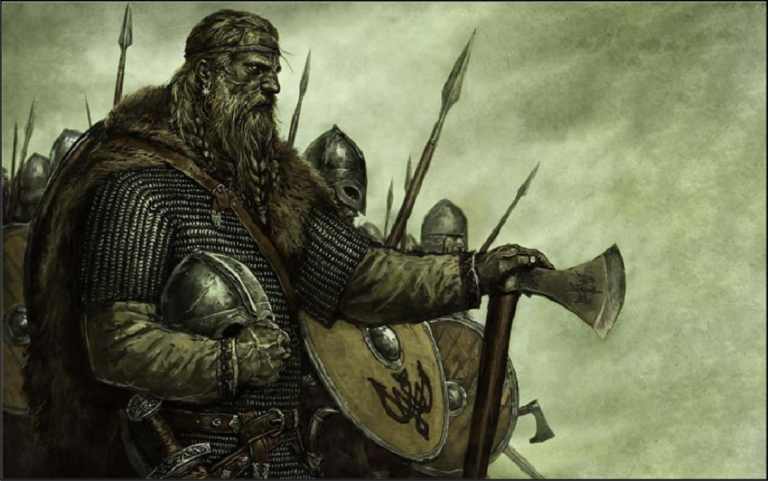
And no — the helmets did not have horns. That is a 19th-century Romantic invention. Actual Viking helmets were simple iron or leather caps, often with a nose guard. Practical, not theatrical.
The Beginning of the Viking Age: The Raid on Lindisfarne
The traditional start of the Viking Age is 8 June 793 AD — the date of the raid on the monastery of Lindisfarne, a holy island off the northeast coast of England. The attack was shocking not merely for its violence but for its audacity: a sacred site, believed to be under divine protection, ransacked by pagan warriors from the sea. The monk Alcuin of York wrote in horror: “Never before has such terror appeared in Britain.”
What drove this sudden expansion? Population pressure in Scandinavia created a generation of young men with no land to inherit. Improved shipbuilding technology gave the Norse an unprecedented maritime advantage. And the post-Roman decline of coastal defences left rich, poorly defended targets temptingly available.
Longships and the Age of Exploration
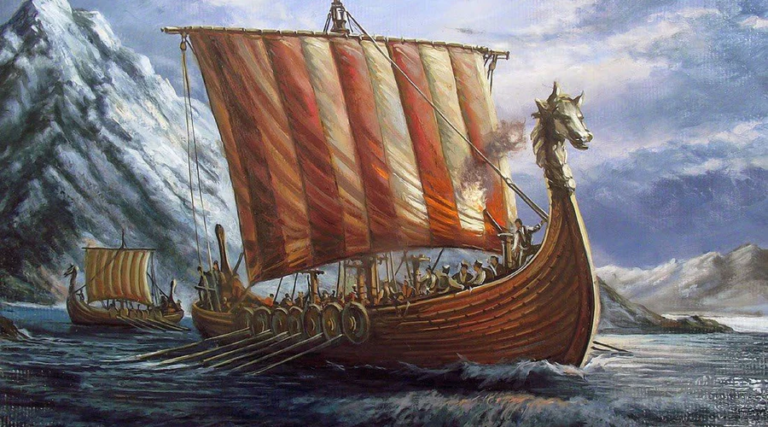
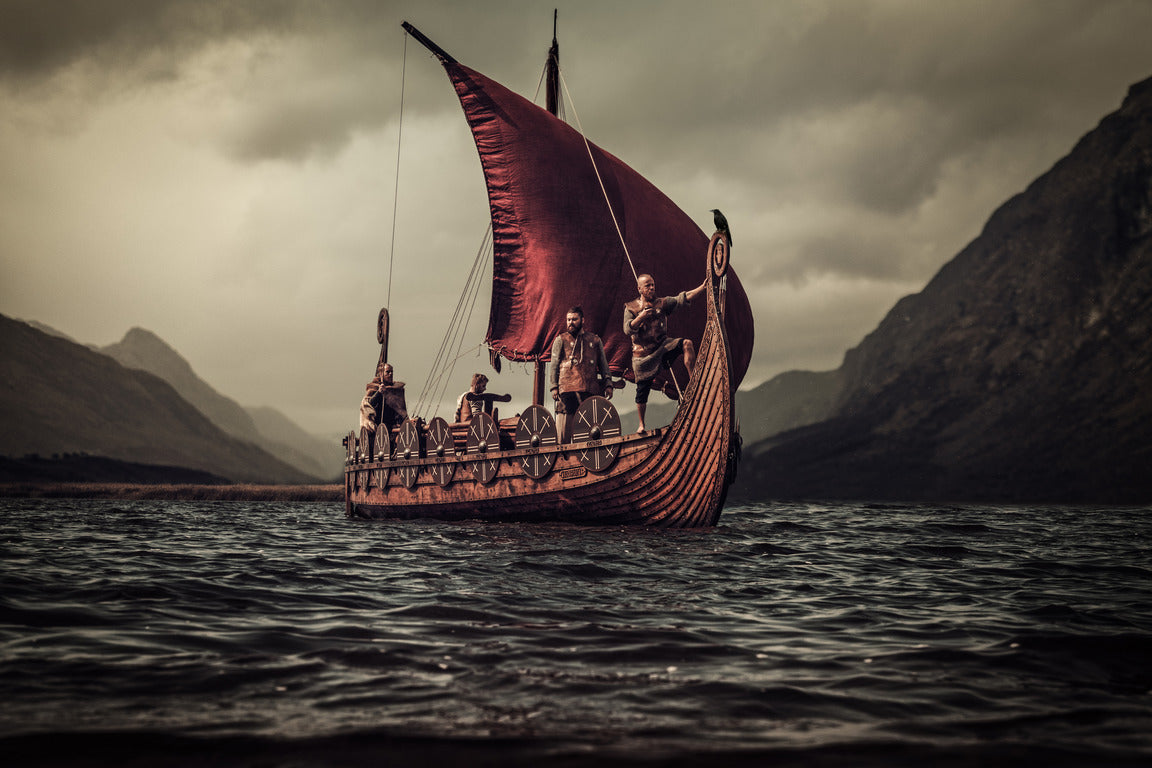
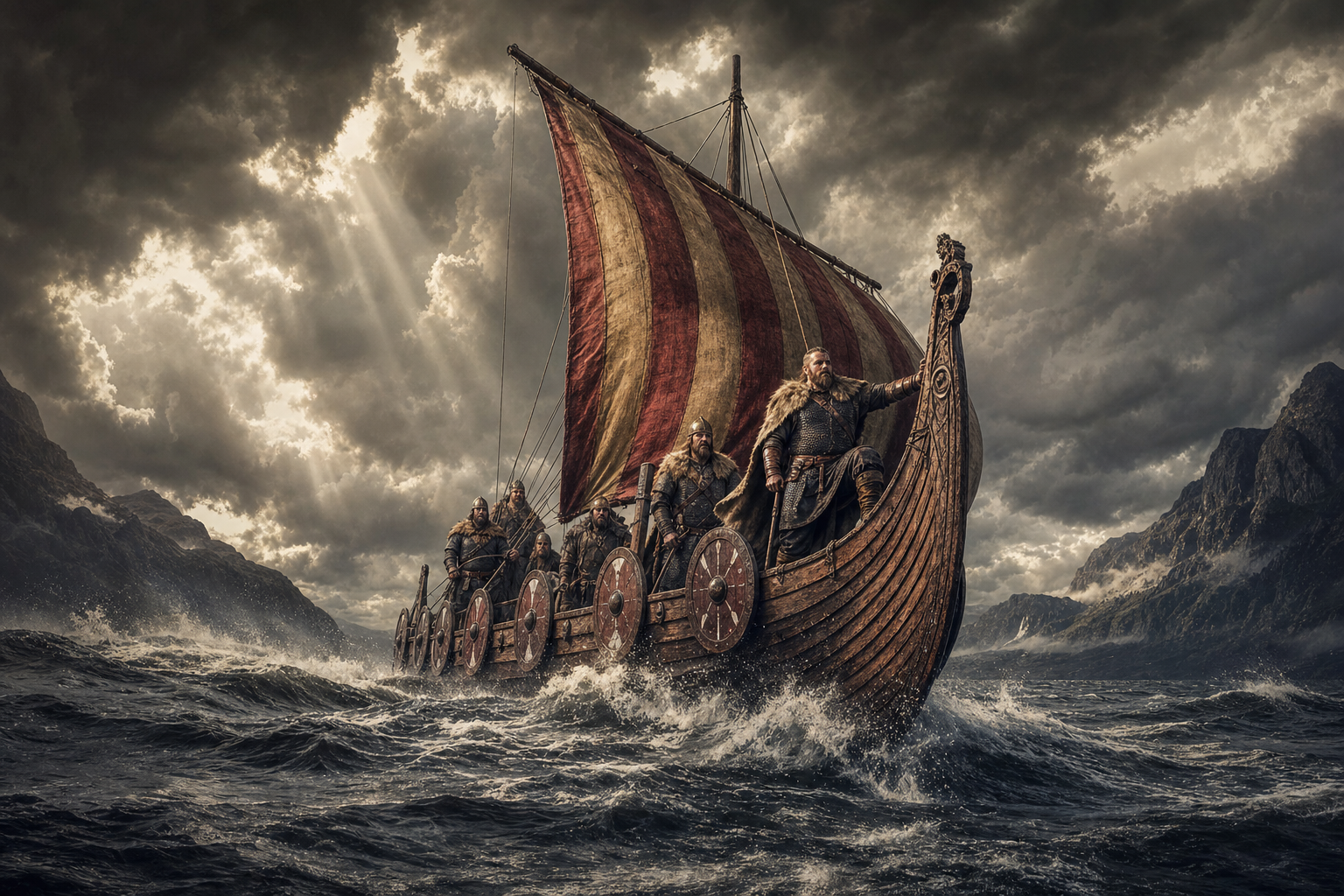
The Viking longship is one of the great technological achievements of the medieval world. Clinker-built, shallow-draughted, powered by both sail and oar, and capable of genuine ocean crossings, the longship gave the Norse a mobility that no other medieval people could match.
The Norse exploration of the North Atlantic stands as one of history’s great adventures. Erik the Red discovered Greenland around 985 AD. His son Leif Eriksson sailed further still, landing on the coast of North America around 1000 AD. The remains of a Norse settlement at L’Anse aux Meadows in Newfoundland, Canada — confirmed beyond doubt — prove the Norse reached the Americas five centuries before Columbus.
Going east, Varangian traders established the routes that became the foundations of Russia and Ukraine. Viking traders reached Baghdad and Constantinople, trading furs, amber, and slaves for silver, spices, and silk.
Viking Society: Jarls, Karls, and Thralls
Norse society was hierarchical but not rigidly feudal. At the top were the jarls — powerful chieftains. Below them were the karls — free men and women, the backbone of Norse society. At the bottom were the thralls — slaves, often captured in raids.
What distinguished Norse law was the Thing — the assembly where free men gathered to settle disputes, make law, and hold their leaders accountable. The Althing of Iceland, established in 930 AD, is one of the world’s oldest parliaments. The Norse concept of law was not handed down from a king by divine right; it was negotiated by free men in an open assembly.
Viking Beliefs and the Old Norse Religion
The Vikings were deeply religious. Sacrifices (blót) were made at key points in the calendar. Runes were carved on weapons, memorial stones, and objects of power. Burial rites were elaborate: wealthy warriors might be interred in ship burials with weapons, horses, and provisions for the afterlife journey.
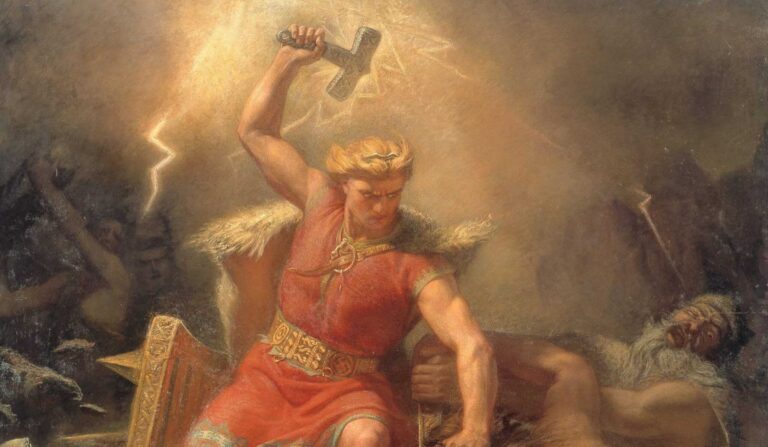
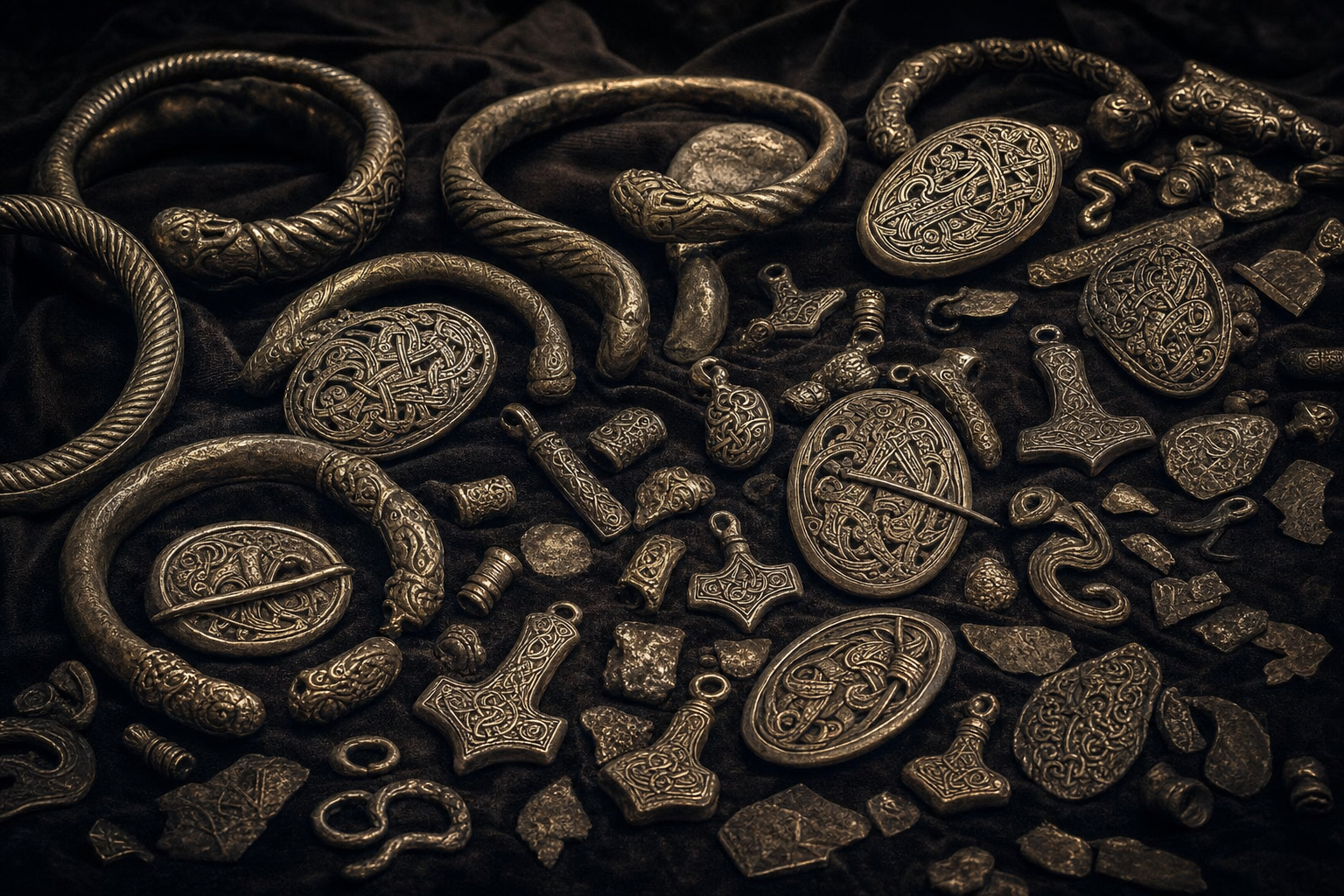
This spiritual dimension was expressed materially through jewellery. A Norse warrior wearing a Thor’s hammer pendant was not merely decorated — he was armoured with divine meaning. Today, those who feel a connection to Norse beliefs continue this tradition through Viking rings bearing runes, Valknut symbols, and serpent motifs that carry the same weight of meaning they did a thousand years ago.
Trade, Craftsmanship, and Viking Wealth
The Norse were celebrated for their metalwork — in silver, gold, and bronze. Intricate knotwork, animal interlace, and mythological imagery adorned everything from sword hilts to drinking horns. The great trading towns of Hedeby and Birka were cosmopolitan centres where Norse merchants exchanged goods with traders from across Europe and the Islamic world.
Arm rings were not merely decorative — they were currency. Silver arm rings of standardised weight were cut apart (hack silver) and weighed out in transactions. A chieftain’s generosity was measured in the rings he gave to loyal warriors. This tradition echoes today in the enduring popularity of Viking bracelets and arm rings as expressions of Norse identity and heritage.
Women in the Viking Age: Shield-Maidens and Household Sovereigns
A 2017 genetic analysis of a high-status Viking burial at Birka confirmed that the warrior interred with a full military kit was biologically female. Norse women held significantly higher social status than their contemporaries in much of medieval Europe. A Norse woman could own property, divorce her husband, run a farm independently, and speak in legal proceedings. The húsfreyja — the lady of the house — held genuine authority over the household and wore the keys to the household stores as a badge of her power.
The End of the Viking Age
Historians date the end of the Viking Age to 1066 AD. In September, the Norwegian king Harald Hardrada invaded England and was killed at the Battle of Stamford Bridge. Days later, Harold Godwinson’s exhausted army marched south to face William of Normandy — himself a descendant of Vikings — at Hastings. The Norman Conquest began.
The Viking Age wound down as Scandinavian societies converted to Christianity, centralised kingdoms replaced the old chieftain system, and the political landscape of Europe changed. The last great Viking expedition is sometimes considered the Norwegian king Sigurd the Crusader’s journey to the Holy Land in 1108.
The Viking Legacy: Why Norse Culture Endures
The influence of the Viking Age runs deeper than most people realise. The English language contains hundreds of Norse loanwords: sky, window, knife, egg, husband, anger, law, ugly. The names of days of the week honour Norse gods. The settlement of Iceland, Greenland, and North America expanded the known world.
Beyond measurable legacies, there is a set of values that resonate across time: courage in the face of overwhelming odds, loyalty to your community, the pursuit of wisdom even at great personal cost, craftsmanship as devotion. These values, embedded in the myths and histories of the Norse world, speak to something universal in human experience.
That is why Norse culture has never really gone away. It lives in modern tattoos, in the designs of video games and streaming epics, in the runes carved into wedding rings, and in the growing communities practising Asatru. For those who feel this pull, explore our full collection of Viking rings and Viking bracelets, each crafted to honour the artistry and spirit of the Norse world. Wear the legacy.
Frequently Asked Questions About the Viking Age
Did Vikings really wear horned helmets?
No. The horned helmet is a 19th-century Romantic fantasy. Actual archaeological finds show Viking helmets were simple rounded iron or leather caps, sometimes with a nose guard. The most famous surviving example — the Gjermundbu helmet from Norway — is a plain hemispherical iron cap with eye and nose protection.
What were Viking longships made of?
Primarily oak, using clinker construction where the hull planks overlap each other, creating a flexible structure that could flex with ocean waves. They were remarkably fast and shallow-draughted, able to cross the open Atlantic and also navigate shallow rivers and land directly on beaches.
Where did the Vikings explore and settle?
Norwegian Vikings colonised the Faroe Islands, Iceland, Greenland, and briefly North America. Danish Vikings settled in England, Ireland (founding Dublin), and France (Normandy). Swedish Vikings established trade routes through Russia and Ukraine, trading with Constantinople and the Islamic world.
Why did the Viking Age end?
The Viking Age ended gradually, driven by the Christianisation of Scandinavia, the consolidation of stronger centralised kingdoms in England and France, and demographic changes within Scandinavia itself. The conventional end date of 1066 AD marks the Battle of Hastings, where William of Normandy — a descendant of Vikings — conquered England.